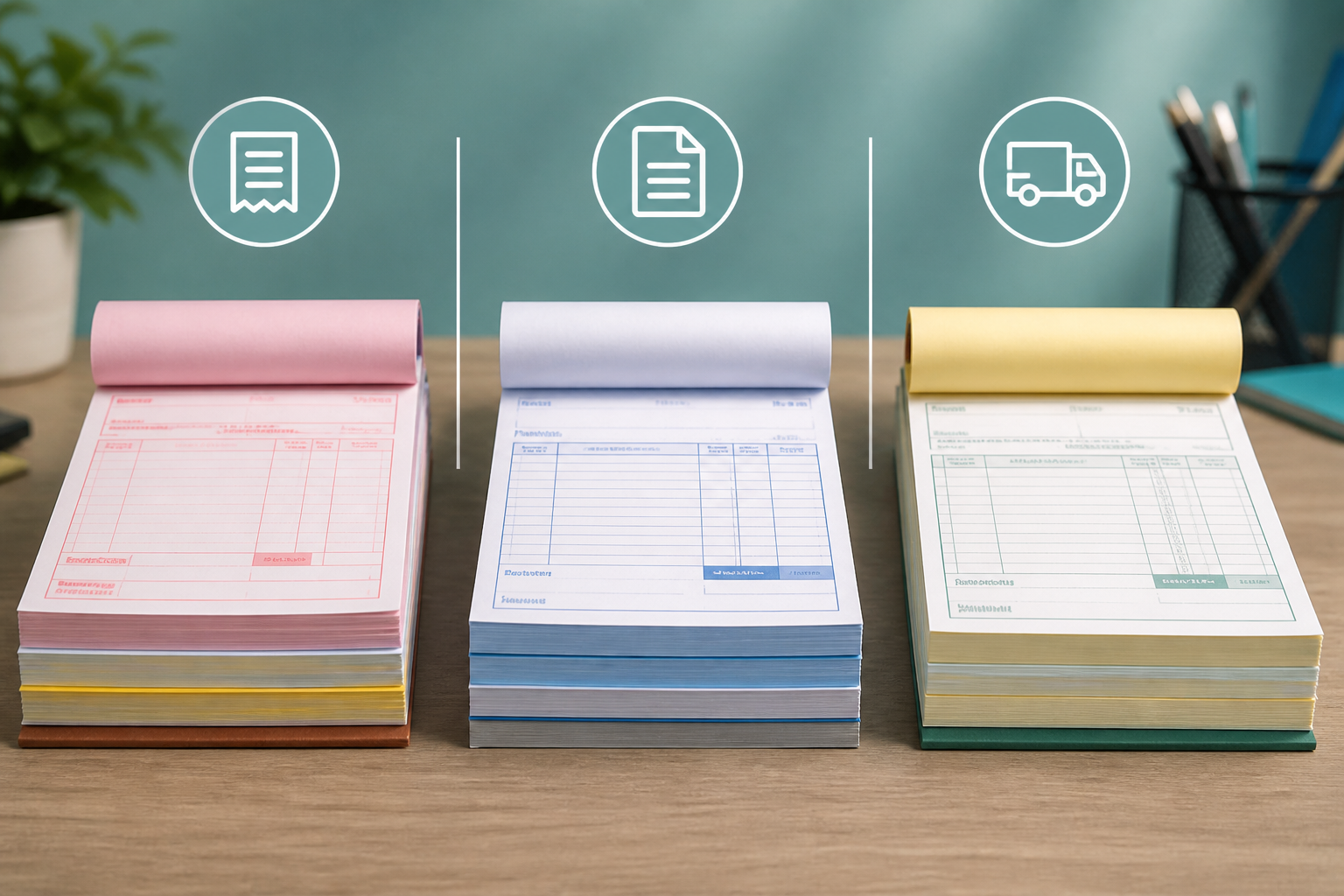
Bill Book vs Invoice vs Challan: What's the Difference?
Every business—whether it's a retail shop, manufacturer, wholesaler, transport company, or service provider—uses business documents to record transactions and move goods. However, many business owners and employees often confuse Bill Books, Invoices, and Delivery Challans.
Although these documents may appear similar, they serve completely different purposes.
Understanding when and how to use each document helps businesses stay organized, maintain accurate records, improve customer communication, and comply with applicable tax and accounting requirements.
This guide explains the key differences between Bill Books, Invoices, and Challans in a simple, practical way.
Why Understanding These Documents Matters
Using the wrong document can create confusion in accounting, inventory management, customer communication, and internal record keeping.
Choosing the correct document helps your business:
- Maintain organized records
- Improve billing accuracy
- Simplify accounting
- Track goods efficiently
- Build customer confidence
- Reduce documentation errors
- Support smoother audits and business operations
What Is a Bill Book?
A Bill Book is a printed booklet used to create sales bills or cash bills for customers. It is commonly used by businesses that need a quick and practical way to record sales while keeping duplicate or triplicate copies for office records.
Most bill books are printed on NCR (No Carbon Required) paper, allowing businesses to create multiple copies without using carbon sheets.
A Bill Book Typically Includes:
- Company Name
- Business Logo
- Address
- GST Number (if applicable)
- Bill Number
- Date
- Customer Name
- Product Details
- Quantity
- Price
- Tax Details
- Total Amount
- Authorized Signature
Common Users
- Retail Shops
- Medical Stores
- Restaurants
- Hardware Shops
- Automobile Workshops
- Electrical Suppliers
- Local Businesses
What Is an Invoice?
An Invoice is a formal commercial document issued by a seller to a buyer requesting payment for goods or services provided.
Unlike a simple bill book, invoices are often generated using accounting software or ERP systems and contain detailed financial information. They are widely used in B2B transactions and are an important part of business accounting.
A Professional Invoice Usually Contains:
- Invoice Number
- Invoice Date
- Buyer Details
- Seller Details
- GST Information
- HSN/SAC Codes
- Product Description
- Quantity
- Unit Price
- Discount
- Tax Breakdown
- Total Payable Amount
- Payment Terms
- Bank Details
Invoices help businesses maintain financial records and support tax reporting where required.
Common Users
- Manufacturers
- Wholesalers
- Exporters
- Corporate Companies
- Distributors
- Service Providers
- E-commerce Businesses
What Is a Delivery Challan?
A Delivery Challan is a document that accompanies goods while they are being transported. It records the movement of goods but does not necessarily represent a sale or payment.
Delivery challans are commonly used when goods are sent for job work, stock transfers, samples, repairs, or any situation where an invoice is not issued at the time of dispatch.
A Delivery Challan Usually Includes:
- Challan Number
- Dispatch Date
- Customer Details
- Delivery Address
- Vehicle Information
- Transport Details
- Product Description
- Quantity
- Unit
- Receiver Signature
- Company Seal
A delivery challan acts as proof that goods have been dispatched or delivered.
Common Users
- Manufacturing Companies
- Logistics Companies
- Transport Businesses
- Construction Companies
- Industrial Suppliers
- Warehouse Operations
Bill Book vs Invoice vs Challan – At a Glance
| Feature | Bill Book | Invoice | Delivery Challan |
|---|---|---|---|
| Primary Purpose | Record sales | Request payment | Record movement of goods |
| Used During | Sales transaction | Billing and accounting | Dispatch and delivery |
| Payment Information | Yes | Yes | Usually No |
| Tax Details | Optional or simplified | Comprehensive | Usually not the primary purpose |
| Goods Transportation | No | Sometimes | Yes |
| Duplicate Copies | Yes | Optional | Yes |
| Customer Signature | Optional | Optional | Usually Required |
| Inventory Tracking | Limited | Moderate | Excellent |
| Accounting Use | Basic | Primary | Supporting document |
When Should You Use a Bill Book?
Choose a bill book when:
- Selling directly to customers
- Running a retail store
- Issuing quick handwritten bills
- Maintaining duplicate copies
- Recording daily cash sales
It is ideal for businesses that need a simple and reliable billing solution.
When Should You Use an Invoice?
An invoice is the right choice when:
- Selling to another business
- Requesting payment
- Recording detailed financial transactions
- Maintaining accounting records
- Using accounting or ERP software
Invoices provide a complete financial record of the transaction.
When Should You Use a Delivery Challan?
Use a delivery challan when:
- Sending goods before invoicing
- Transferring stock between branches
- Dispatching goods for job work
- Delivering product samples
- Returning repaired goods
- Moving inventory between warehouses
It ensures there is a documented record of the goods in transit.
Can a Business Use All Three Documents?
Yes. In fact, many businesses use all three documents as part of a single workflow.
Example Workflow
- Receive a customer order.
- Prepare a Delivery Challan to dispatch the goods.
- Deliver the products to the customer.
- Issue an Invoice for payment.
- Maintain a Bill Book or printed copy for internal records (if your business uses printed billing).
Using the right document at each stage improves efficiency and helps maintain accurate records.
Why Custom Printed Books Make a Difference
Custom-printed bill books and challan books offer several advantages over generic stationery.
Professional Branding
Display your company logo, business name, contact details, and GST information.
Faster Documentation
Pre-printed formats reduce writing time and improve productivity.
Better Record Keeping
Duplicate and triplicate copies make filing and audits much easier.
Consistent Business Identity
Every document reflects your brand and builds trust with customers.
Custom Layouts
Design forms according to your business workflow instead of using standard templates.
Which Industries Need These Documents?
These documents are widely used across industries, including:
- Retail Stores
- Manufacturers
- Wholesalers
- Logistics Companies
- Hospitals
- Medical Stores
- Construction Companies
- Engineering Firms
- Automobile Workshops
- Food Distributors
- Furniture Manufacturers
- Electronics Dealers
- Packaging Companies
- Industrial Suppliers
Tips for Choosing the Right Printing Partner
If you are ordering custom bill books or challan books, look for a printing company that offers:
- Premium NCR Paper
- Sharp Offset or Digital Printing
- Custom Sizes
- Serial Numbering
- Perforation
- Company Branding
- Durable Binding
- Fast Turnaround
- Bulk Printing Options
High-quality printed documents improve both functionality and your company's professional image.
Frequently Asked Questions
Is a bill book the same as an invoice?
No. A bill book is a printed booklet used to issue sales bills, while an invoice is a formal commercial document used for billing and accounting.
Can a delivery challan replace an invoice?
No. A delivery challan records the movement of goods. If payment is due, an invoice is generally required to complete the billing process.
What is an NCR bill book?
An NCR bill book uses No Carbon Required paper to produce duplicate or triplicate copies without carbon sheets.
Which businesses should use custom printed bill books?
Retail stores, wholesalers, manufacturers, service providers, transport companies, and healthcare businesses can all benefit from customized bill books.
Conclusion
Although Bill Books, Invoices, and Delivery Challans may look similar, they each serve a distinct purpose in business operations. A bill book helps record everyday sales, an invoice documents and requests payment, and a delivery challan tracks the movement of goods before or during delivery.
Using the correct document at the right stage not only improves efficiency but also strengthens record keeping, supports accounting processes, and presents a more professional image to customers. For businesses that rely on printed stationery, investing in high-quality, customized bill books and challan books is a practical way to streamline daily operations while reinforcing your brand identity.